Critter Visits

It’s getting to be that time of year again here in the upper Midwest.

Time to check for and seal up gaps around doors, windows, and the foundation where cold air and critters may slip in during the upcoming winter months.

One place that definitely should be sealed up is where an HVAC/central air conditioning system makes its way into our home. As I learned the hard way this summer, apparently that is a popular entry point for pests.

For a week or so this past August, I had more mouse sightings in my home than I care to admit.

It was baffling—and more than a little unnerving, as mice totally freak me out—until a pest control guy named Steve pointed out what most likely was the source of the problem. There was a good-sized gap where the pipe from the air-conditioning unit ran into my house.

Sure enough, after sealing the gap the mouse issue went away.

But that didn’t spell the end of my encounters with small four-legged critters in recent months. My latest came in early fall while watering my outdoor plants.

When I went to pour from the watering can nothing came out. I checked the spout to see if it was clogged with leaves as it had been one other time but that didn’t appear to be the problem. I tried again but still no water came out.

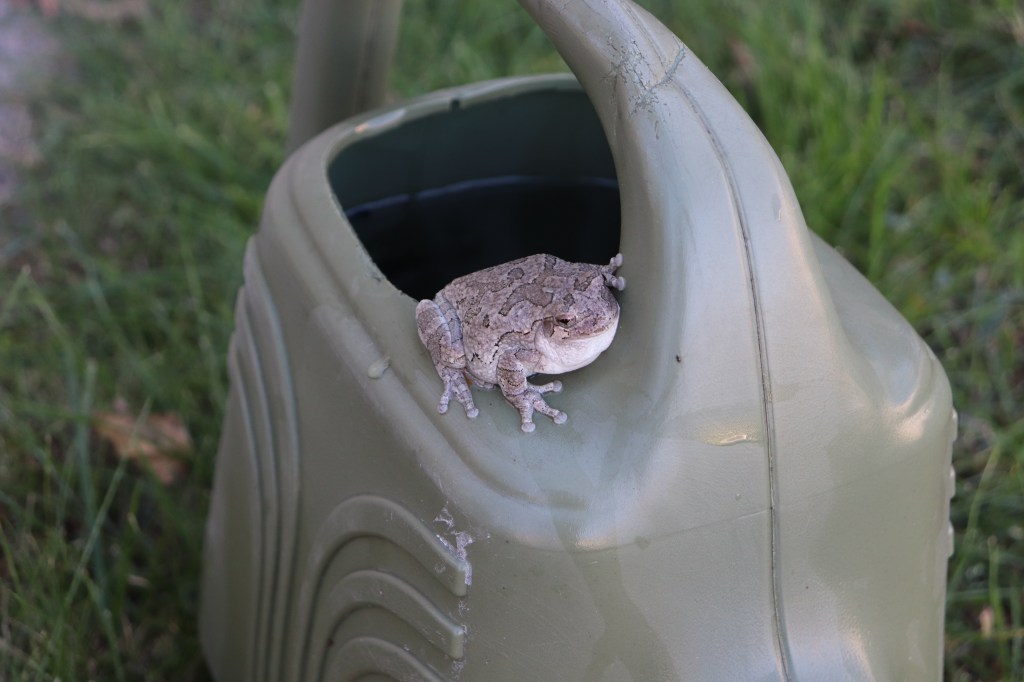
Apparently the clog was below the spout so I decided to dump all of the water out and give the can a thorough cleaning. As I was doing so the culprit appeared.  A toad came out from inside the can and clung onto the top edge of it.

I have to admit that I was pretty startled. I am not afraid of toads as I am of mice, but I can’t say that I’m a huge fan of them, either. And I certainly didn’t expect to see one come crawling out of my watering can.

I took some photos of the toad before it hopped off. Then I picked up the watering can to finish cleaning it out.

That is when another toad hopped out.

This one was a brighter green than the other one. It also was more active. It only stood still for a few seconds before it hopped off.

Where the two toads came from and hopped off to I have no idea. And that’s just fine with me as long as they—and the mice—stay out of my house.

Late Bloomers

As we say goodbye to summer and hello to fall one of the many things that I am grateful for is late bloomers.

While fall is a beautiful time of year here in the upper Midwest—what with the changing colors and abundant sunshine that we usually get—I have to say that it’s always hard to see summer go. Its abundance of warm air, sunshine, birds, plants, and flowers is hard to beat for the amount of joy that it brings into our lives.

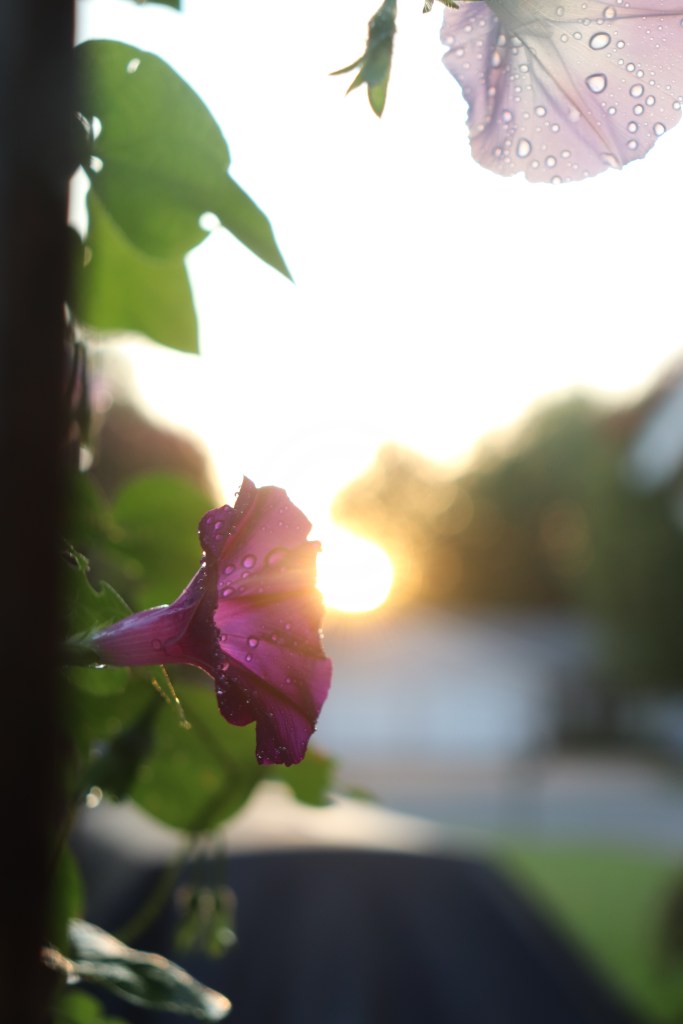
Having to see these things go is one reason why I enjoy the sight of late bloomers this time of year. It is mid October as I write this and I have tomato, morning glory, and cosmos plants that are still blooming in my garden.

The sight of them helps to keep alive a taste of summer even as it comes to a close. It also gives me hope in my personal life as well.

Without divulging my exact age—yes, I am getting a little vain, defensive and probably in a fair amount of denial about it—I have to admit that I am well into what are often referred to as my “sunset” years.

Sometimes this realization makes me sad. But then I remember what my faith teaches me.

The Bible is filled with people who God used to do great things when they were well into their “sunset” years.

The Bible also tells us that for those who believe, our “sunset” years are actually a sunrise because the paradise of heaven awaits us.

It’s a reassurance that helps me to strike a happy balance between holding on and letting go. I can hold on to the sunshine of summer while letting go of my disappointment that it doesn’t last longer.

All while giving thanks for the tomatoes, morning glories, cosmos, and all of the other late bloomers out there!

Favorite Colors

Back when we were kids my sister Betsy and I had a running argument about our favorite colors.

She maintained that there is more blue in the world while I argued that there is more green.

Looking back, I am willing to admit that Betsy was probably right. With the sky overhead and the numerous lakes, rivers, and oceans below, there is probably way more blue in the world than there is green.

But I still say that my favorite color is pretty well-represented as well, what with all of the grass, plants, and leaves that cover God’s green Earth.

There are a couple of reasons why I recently found myself thinking of green and blue.

One was a weekly visit to the family lake place in northern Minnesota. The sky always seems a little bluer and the trees a little greener up north.

The other was an excellent sermon at my church recently—Peace Lutheran in Eau Claire, Wisc.—about how we humans are a part of God’s creation. The Bible tells us that God made us from dust, after he created the heavens and the earth.

Science backs up this link between us humans and the rest of God’s creation in that we have learned that human DNA has much in common with the DNA of other living things on earth.

It’s good to remember the connectedness we have with the other parts of God’s creation, Pastor Ethan shared in the sermon, because it helps to keep us grounded.

As humans, it seems, we have a tendency to overemphasize the mental side of things. We can easily get so caught up in our head—our thoughts, worries, fears, and ruminations–that we go down the proverbial rabbit hole and wind up getting lost in our own little world.

One good way to prevent this from happening is to stay grounded in the physical part of God’s creation.  And one of the many awesome parts of God’s creation that he/she has blessed us with is color.

There are the aforementioned green and blue.

The brown and white sands of the beaches.

The brown and black soil of the fields.

The black, brown, gray, and red rocks of the mountains.

The yellow, red, and orange leaves in the fall.

And the brilliant greens, reds, pinks, and purples of the northern lights that I keep seeing photos of online but never seem to see in person.

Part of that is because I live in a fairly big city where bright lights, homes, buildings, and trees block my view of the horizon.

Another is that I don’t do my daily run after dark.

If I did run late in the evening, I’d probably come to an open stretch where I’d have a full view of the horizon and be treated to the sight of northern lights if they were out.

But I am mainly a morning—and sometimes early evening—runner. So the aerial display of colors that I am often treated to comes via sunrises, sunsets, and amazing morning and evening skies. And they are more than enough to remind me of a couple of things.

One is that my sister was probably right. There probably is more blue in the world than there is green.

Two is that with so many beautiful colors above, below, and around us, our world must have been created by a loving God.

The chance to enjoy all of this beauty is one of the many things that I love about running and walking outdoors for exercise.

Like many people, one way that I find God is in the G.O.D. (great out doors).

Hydration is Good for the Nation

During a recent hot (85 degrees or so) and humid 9-mile run I found myself conjuring up some memories related to hydration.

One memory dates back to an event that I worked at a decade or so ago.

It was a “Safety Days” vendor demo that highlighted home and childhood safety products. A band called “McGruff and the Crime Dogs” played at the event and one of their songs was called “Dehydration is Bad for the Nation.”

This song popped into my head during the recent hot and humid run, probably because about halfway through it I was starting to feel pretty parched. The nearest water fountain—or “bubbler” as they are referred to by some here in Wisconsin—was at a park several miles up the road.

Fortunately I was able to make it to the park without any issues other than slowing considerably and sweating profusely. As I was rehydrating at the fountain I caught sight of another runner passing through the park, who turned out to be longtime friend John Konkel.

Our first and only topic of conversation was—you guessed it— the heat and humidity. John mentioned Grandma’s Marathon that was taking place that morning and how the last time he ran there it was a “black-flag” event.

An event that is black-flagged means that it is cancelled while a yellow flag means to proceed with caution and red with extreme caution.

John’s mention of Grandma’s brought back another memory I have related to hydration.

The last time that I ran Grandma’s—also my last marathon—I don’t believe there was yet any kind of flag system used for rating distance-event weather conditions.  There also wasn’t near as much knowledge about the importance of staying hydrated.

As I recall, it was a sunny, fairly warm day—probably in the low 60s. Besides that I don’t remember much other than that I finished the marathon and the last few miles seemed to take forever.

Back at my motel room afterwards, it wasn’t long before I had a splitting headache and was throwing up. I spent a long, miserable afternoon lying in bed with a cold rag on my head while learning a painful lesson about dehydration.

A couple of my takeaways from that unpleasant experience were that the marathon is not for me and that it’s important to take in fluids during a distance event.

During my last warm-weather race—the Steamboat Classic 15K in Peoria, Ill.—I stayed hydrated by doing something that I never would have dreamed of doing back during my more competitive days of running. I took the time to stop at the water stops and take in fluids.

It’s something that I’d never done before because I always figured that I’d lose too much in the way of finishing time and place.

What I found out, though, was quite the opposite. Whatever time and place I lost by stopping to take a drink, I more than gained back after I resumed running. Taking the time to stay hydrated, I learned, can definitely save time in the long run.

More importantly, I’ve learned that staying hydrated can save a lot of suffering. Not just in running but in life. As anyone who has been dehydrated can tell you, it is not a pleasant experience. Not to mention that it can lead to a whole host of health issues.

McGruff & The Crime Dogs are right–“Dehydration is Bad for the Nation.”

It’s almost always a good idea to take the time to take a drink of water.

Celebrating Our Freedoms Through Running

This year I did the fourth 4th of July run of my life.

In Minnesota I have run the Langford Park 4-Mile in St. Anthony Park, the Firecracker 10K in Excelsior, and Grandpa’s Run for the Walleye 5K in Cross Lake.

Now I can add the Mondovi EMS 5-Mile in Wisconsin to the list of 4th of July fun runs I have done.

When I say “fun run” I can just hear a chuckle from Landon, one of my former co-workers.

“Huh,” he chuckled, when I invited him several years ago to a fun run that I was helping to organize through the ITC running club that I am involved with. “Fun and run do not go together.”

I totally understand why running is probably not on many people’s list of fun things to do on the 4th. If you’re not trained for it—and oftentimes even when you are– running can be pretty painful.

This can especially be the case when the weather is nasty, such as on hot, humid mornings like we had this year on the 4th.

Despite the steamy conditions, however, running the Mondovi EMS 5-Mile was a great way to kick off Independence Day. And a very fitting one as well.

Some of the many things that running on a regular basis helps to give us freedom from are obesity, heart disease, high blood pressure, anxiety, dementia, and depression.

Another thing that participating in fun runs can help to give us freedom from is loneliness, which many reports have found is a significant problem for many people these days.

While it’s certainly possible to participate in a running event and not talk to anyone, my experience has almost always been quite the opposite. At most every running event I have participated in over the years—and there have been hundreds of them—I have almost always made some new acquaintances and/or reconnected with some long-time friends.

While running is not a cure-all for any of the above-mentioned issues, it definitely can be very helpful in giving us freedom from them. That is why I plan to keep running and walking for exercise on a regular basis for as long as I am able to do so.

New Seasons

Among the many things that I enjoy about running, walking, and biking outdoors for exercise is experiencing the seasons.

This is especially the case here in the upper Midwest where we have four distinct ones to experience—spring, summer, fall, and winter.

I can’t say that I have a favorite season—OK, it’s probably summer!—but I can say that I have a favorite part of one. It’s early spring when the trees, plants, and flowers start blooming.

Seeing them come to life in such colorful fashion after looking so drab and lifeless all winter is always super uplifting.

That has been especially true for me this spring because this past winter was a tough one. In mid-January I had to say goodbye to my best buddy Caleb, a 14 and a half-year-old dog.

It was a loss that hit me hard. Not only did it make me sad, it made the landscape appear especially gray and barren this past winter when I was out for my morning run.

That is why the spring bloom has been especially sweet this year. It is a welcome reminder that even after a long, dark winter God brings us new life in the spring.

Couch to 5K New Year Resolution

I’ve never been one for making New Year resolutions so it’s a little surprising to find myself making one here.

It’s also a little surprising what prompted me to be making this resolution.

For well over 20 years now I have been running along the Chippewa River in Eau Claire, Wisc. most every Saturday morning.

During that time I and my running buddies have seen quite a few sights along this scenic waterway.

We’ve seen eagles, cranes, ducks, geese, deer, and turtles.

Tubers, kayakers, boaters, and fishermen.

Countless beautiful sunrises, ice formations, fast water, and sea smoke.

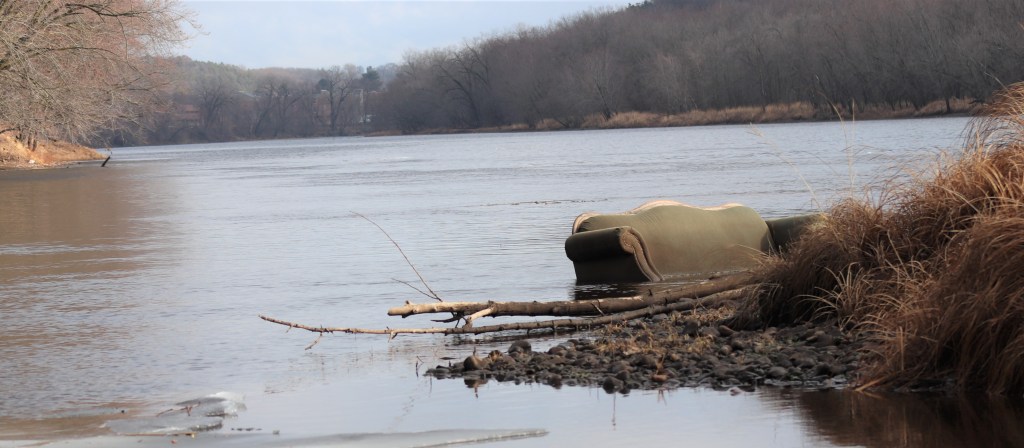
One thing that we had never seen while running along the Chippewa River—at least not until recently– is a couch. But there it has been for the last three or four weeks, sitting in a foot or two of water just upstream from the Clairemont Avenue bridge.

It’s a pretty steep bank from the running trail down to where the couch sits in the water below, so it’s a bit of a mystery as to how the unsightly piece of furniture got there.

Did it get pushed down the bank and then carried into the water?

Was it given such a strong “heave-ho” from above that it cleared the shoreline and landed in the river?

Did it get tossed off one of the bridges a short ways upstream and somehow float downstream to its shallow-water resting place? 

However the couch wound up in the river, it was most likely dumped there by someone who wanted to avoid the cost of having it hauled away to the landfill.

Seeing this kind of illegal dumping reminded me of what the late former City of Eau Claire Public Works Director Brian Amundson told our running club several years ago when he was meeting with us to discuss the fundraising we were doing for the mile markers that now adorn the city’s portion of the Chippewa River Trail. One of our members asked about the possibility of the markers being vandalized.

I don’t remember Brian’s exact words but his reply went something like this:

“We’ve found that the best response to vandalism is to remove it as soon as possible,” he said. “We’ve found that leaving vandalism unaddressed has a way of encouraging more vandalism.”

Brian’s words stuck with me because I find them to be instructional for other areas of life.

Take unhealthy thoughts and behaviors, for example. Just like vandalism, they have a way of encouraging more of the same. So the sooner we root them out the better.

Here’s hoping that in the days ahead we do our best to keep our hearts, minds, and rivers clear of unwanted trash like ratty, water-logged couches. Happy Trails in 2025!

Light in the Darkness

This time of year, the countdown is on.

For many people, it’s the countdown to Christmas.

“Only – Days Til Christmas” is a countdown that is fairly common to see this time of year on marquees and calendars and the like.

As someone who celebrates Christmas, I definitely pay attention to this countdown.

But the older I get, it seems, the other December countdown that I also pay attention to is the countdown to the solstice.

I don’t think that I am among those who suffer from seasonal affective disorder (SAD). But I do know that the shorter, darker days that the time between the end of daylight savings and the solstice brings has been especially challenging this year.

That is because this year has been full of health challenges for me and my family. “When it rains it pours,” a friend of mine said when I told him about these challenges. “This year sucks,” my brother recently said, when summing things up.

The challenges of 2024 have made the shortest days of the year that mid December brings seem especially dark at times this year. They’re also why I especially looked forward to the Dec. 21 solstice, when the days start getting longer.

It’s not that I suffer from SAD. It’s just that darkness is the last thing I need in a year that has brought plenty of it already.

Besides looking forward to the solstice, a couple of other things that have helped me to get through this “dark” season are faith, daily outdoor time, and Christmas lights.

I’m not a big Christmas decorator, though I do have some holiday trimmings up around the house. And I definitely appreciate more so than ever the neighbors who take the time to decorate the exterior of their homes with Christmas lights that help to brighten a dark time of the year.

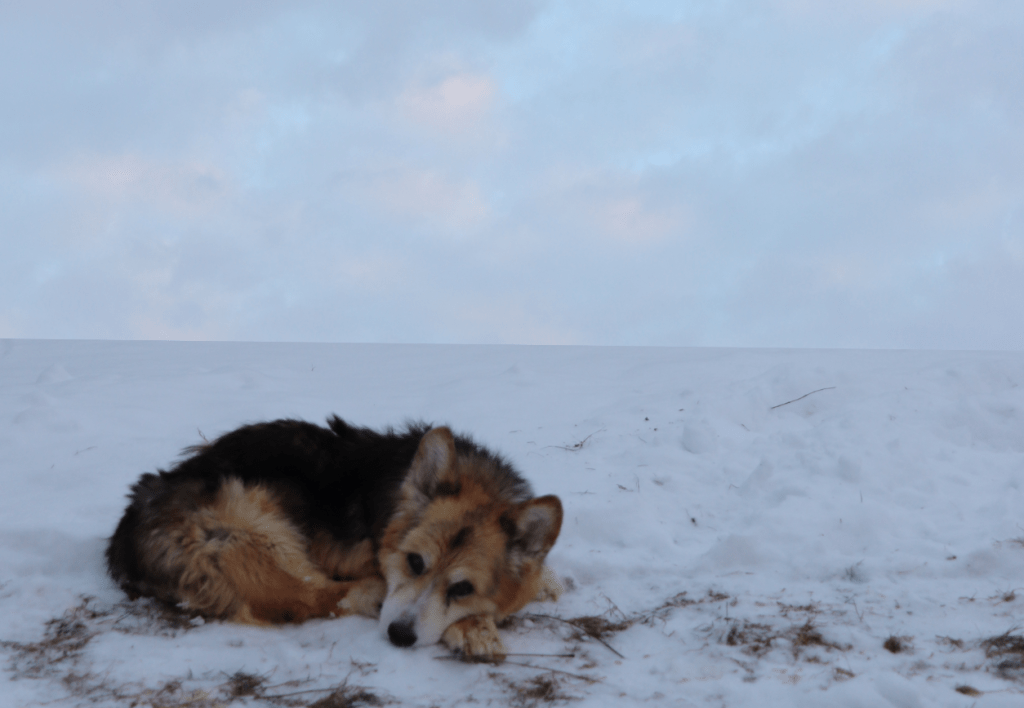
While my four-legged buddy Caleb and I don’t do much walking anymore on account of his rear legs becoming paralyzed recently, we still spend quite a bit of time sitting together outdoors. Getting some fresh air and daylight is especially therapeutic this time of year.

So is having a faith in a God who tells us that “I am the light of the world. Whoever follows me will never walk in darkness but have the light of life.”

Happy Holidays everyone! Hope your holiday season and New Year are bright!

Wet Wheelbarrow Walk

The other day my buddy Caleb and I had what I am calling a wet wheelbarrow walk.

Wet because it was pouring rain out.

Wheelbarrow because I held Caleb’s rear legs up from behind him so that he could walk with his front ones.

I’ve been doing that for a few months now. Ever since Caleb’s rear legs became paralyzed from a condition called degenerative myelopathy (DM).

It’s a genetic disease that some breeds including corgis are susceptible to.

While it’s been difficult to see my buddy lose the use of his rear legs, I am grateful that it didn’t affect him until he was 14. That’s a pretty good long time for any dog to enjoy full mobility, especially a dog with DM.

But as most anyone who has had a dog will tell you, our time with them always seems too short. Caleb is 14 and ½ now—over 100 in dog years—and I’m still having a very hard time accepting that we probably don’t have too many more walks together.

I got Caleb when he was two and for the past 12 years he’s been one of the greatest gifts to come into my life. One of the things that I tell him most every day is that he’s the “best bud ever.”

One of our favorite things to do is to go for a morning and evening walk. After Caleb first lost the use of his rear legs, I thought those days were behind us.

But then I discovered that if I hold up his rear he will march out with his front ones for a walk.

We don’t go far. Maybe a block or so. But it gives Caleb a chance to do two things that he loves—eat grass and drink out of puddles.

There were plenty of puddles the other morning when Caleb and I did our wheelbarrow walk in a pouring rain.

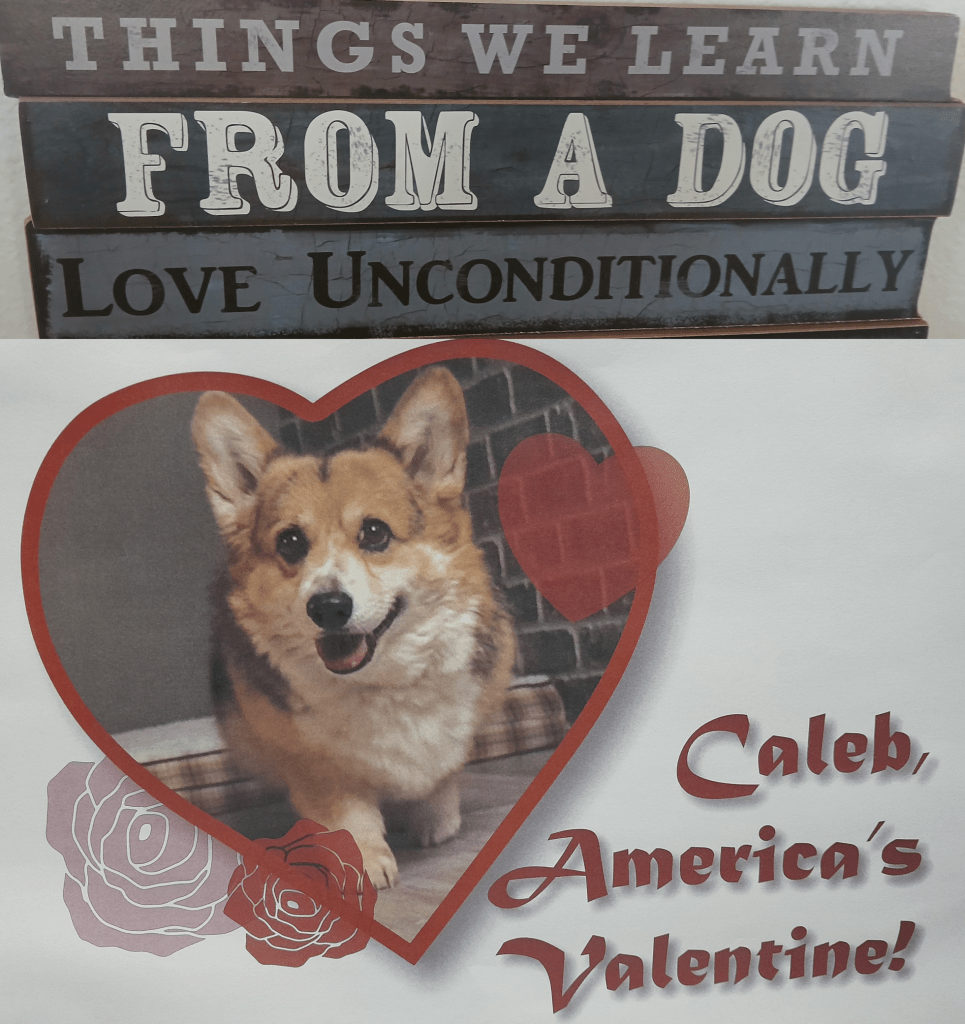
When we got back inside I dried him off in the entryway and decided to take some photos of him. Partly because he was sitting below a wall-hanging that I bought several years ago.

“Things We Learn from a Dog,” it says.

*Love Unconditionally;

*Take a Nap;

*Have a Happy Attitude;

*Play is Good;

*Show Affection;

*Learn New Tricks No Matter Your Age;

*Delight in the Simple;

*Always Be Faithful;

*Protect Those You Love.”

Caleb has taught me all of those things and more. Whatever time we have left together, I am going to do my best to cherish it and look forward to meeting up with him in heaven.

Spring Planting

During my spring planting this season I found myself thinking about one of my favorite Bible verses.

For the second spring in a row I planted cosmos and morning glories. Some of the things that I like about these two annual flowers is that they come in a variety of colors, grow big and tall, and bloom throughout the summer and well into the fall.

All of that is a great big bonus here in my neck of the woods—western Wisconsin—because fall always seems to come all too early. Before we know it, the leaves are falling, the flowers are wilting, and summer is over. That is why flowers that bloom late into the season get bonus points in my book.

 By providing color into the fall when much of the landscape here in the northern climes is starting to go drab and dormant, cosmos and morning glories are a vivid reminder of how miraculous it is that so much beauty can come from something that starts out so small. Every spring when I plant them, I’m amazed at how flower seeds that are not much bigger than a grain of sand can break through the soil and grow into such big, tall, beautiful blooms.

Just as how I am amazed at what an awesome God we have every time I think about what Jesus tells us in Matthew 17:20-21:

“If you have faith as small as a mustard seed, you can say to this mountain, ‘move from here to there’ and it will move. Nothing will be impossible for you.”

I love this verse for a number of reasons.

I love it because it reminds me of how welcoming our God is. He gives his almighty love even to beginners whose faith is still as small as a mustard seed.

I love it because it reminds me of how forgiving our God is. He gives his almighty love even to long-time believers who are struggling with fear, doubt, setbacks, or sin that have reduced their faith to mere seeds.

I love it because it reminds me of how empowering our God is. Even if all we have is faith as small as a mustard seed, he helps us to do amazing things.

I love it because it reminds me that we have a God who speaks in a language that we can understand. Anyone who has planted flower or vegetable seeds knows how amazingly true it is that great things can grow from the tiniest of beginnings.

Just as anyone who has planted flower or vegetable seeds knows that these great things usually don’t grow on their own. While God does all of the heavy lifting by turning a tiny lifeless seed into a tall, growing, flowering plant, we have to do our part as well.

In the case of vegetable and flower gardens, that means weeding, watering, and pruning. In gardening as in life, when we do our part and let God do his, the results can be amazing.